
The BSF has unearthed at least five under-ground tunnels in the about 192 km of the Jammu front (of the India-Pakistan IB) in the last three years.

Richest Indian Gautam Adani's group, which has grown on acquisitions, has fairly solid fundamentals but debt-funded future acquisitions can start putting pressure on ratings, S&P Global Ratings said on Thursday. Starting out as a commodities trader in 1988, the Adani group has diversified from mines, ports and power plants into airports, data centres and defence. It recently forayed into the cement sector with a $10.5 billion acquisition of Holcim's India units and is also looking to set up an aluminium factory. Most of this expansion has been funded by debt.

India Ratings expects long products demand growth to be sharp, supported by a demand push from the government-led infrastructure investments in affordable housing, railways, rural electrification and road networks.

Ten central trade unions except Bharatiya Mazdoor Sangh are observing one-day general strike on Thursday to protest against various government policies.

'Our civil society here is vibrant, and courageous, although it is beaten up and beaten down, repeatedly.'

Govt to play enabler not handler, India never had more decisive government: PM Modi Prime Minister Narendra Modi on Monday cited his dispensation's push for wide-ranging reforms, including the privatisation of Air India, to assert that the country never had a more "decisive government". Launching the Indian Space Association (ISpA), an industry body aspiring to be the voice of the country's space sector, Modi noted that fields like mining, coal, defence and space have been opened to private players, and said his government's clear policy about public sector enterprises is to open those to private industry where its presence is not required. While opening a host of sectors, the government has built a regulatory environment in which priority has been given to national interest as well as the interests of different stakeholders, he said.

In a double delight, retail inflation eased to a one-year low of 5.72 per cent - staying below the upper tolerance limit for two months in a row, while factory output rose sharply to 7.2 per cent on the back of healthy growth in manufacturing. The retail inflation numbers based on Consumer Price Index (CPI) will provide some room for the Reserve Bank to further moderate the quantum of hike in key interest rate or even press a pause button. The RBI has been on a rate hiking spree since May 2022 in its bid to tame inflation, having raised the repo rate by a cumulative 225 basis points (bps).

The investment climate is going well in India and the private sector should skill their workforce in the interest of its business, Chief Economic Advisor K V Subramanian said on Thursday asserting that he does not foresee any difficulty in demand and supply of the workforce. Addressing 'Times Network India Economic Conclave', Subramanian further said job creation is part of the virtuous cycle that starts with private investments flowing into the country resulting in production, growth, job creation and increase in aggregate demand which in turn leads to more investments in the economy. The investment climate is going well in India. Other things will follow, though with a lag...it is for the private sector to start recognising that it is in their own business interest that they should skill their workforce. This, in turn, will raise the average level of skills in India," he said.

Sectors which attract maximum foreign inflows include services, computer software and hardware, telecommunications, automobile and trading.

Sentiment continued to be weighed down by the government's move last week to withdraw high-value currency notes and disappointing quarterly earnings by some more blue-chip companies, brokers said.
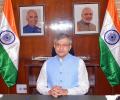
From trusted bureaucrat, to Wharton, MNC executive to businessman, and now politician, the man in charge of two weighty ministries is a unique all-rounder with specialist knowledge.

An infiltration bid was foiled by alert troops along the LoC in Naugam sector

Eight infrastructure industries have posted a growth rate of 8 per cent for September on account of good performance by crude oil, steel and electricity sectors.

The party also promised to end the mafia raj by creating corporations for the sale of liquor and sand mining.
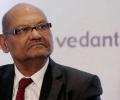
With a robust outlook for mineral-led growth in India, Anil Agarwal-led Vedanta Limited is looking to invest up to $20 billion across its businesses, which includes doubling of silver production and steel capacities. In a virtual press conference had last month, Agarwal said the company planned a capex of $5 billion over a period of three years. The company has not given a timeline for $20-billion investment.

The 30-share Sensex ended 50 points lower at 28,112 and the 50-share Nifty declined 12 points to close at 8,531.

The government was going in the "wrong direction" and it was "highly condemnable" that it did not discuss the proposed changes with trade unions and other stakeholders, says BMS, trade union arm of the RSS.

Agriculture, which accounts for 14% of GDP grew at 3.2% in the quarter

An opportunity to enter a burgeoning sector at a low valuation and favourable policies are propelling some of India's largest corporate groups to scoop up drone start-ups. "Indian corporations lost the race in aerospace and space tech. "No one wants to miss the bus this time. "These are seasoned businessmen and they realise that the market cap of tech companies with problem-solving capabilities will exponentially rise in future," says Vipul Singh, CEO of Aarav Unmanned Systems (AUS).

Skylark Drones, a leading drone platform company that counts Tata Steel, Ultratech Cement, Softbank Energy among its customers has secured $3 million in a pre-series A funding round. It would use the funding to strengthen its product offerings and fuel international expansion.

'Imagine for a soldier -- first you conquer territory after fighting a fierce battle, suffer casualties and then you are ordered to come back to your side of the International Border in India.'
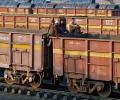
Freight earnings too saw a decline of Rs 8,284 crore to Rs 13,412 crore in the first two months of FY21, compared to Rs 21,696 crore during the same period last year.

The new IIP numbers should spread cheer among those who were part of the Manmohan Singh-led United Progressive Alliance, earlier accused of having presided over a steady deterioration in industrial performance, particularly in the last two years of its tenure, says A K Bhattacharya.

However, a prolonged and intense second wave that curtails oxygen supply to industries for a longer-than-expected period will exacerbate downside risk in affected sectors

The stellar rise in corporate earnings in financial year 2021-22 (FY21) and FY22 did not result in a corresponding boom in capital expenditure (capex), with listed companies' investment in fixed assets rising just 2.3 per cent year-on-year (YoY) in FY22, growing at the slowest pace in the last six years. In comparison, the firms' combined net profit jumped 63.5 per cent YoY in FY22, while net sales increased 31.1 per cent - the fastest pace in over a decade. The 955 non-financial companies in Business Standard's sample reported combined net profit of Rs 7.18 trillion in FY22, compared with Rs 4.39 trillion in FY21 and Rs 2.59 trillion in FY20.

Privatisation of BPCL, which was dubbed India's biggest ever, has been stalled with just one bidder left in the fray after two others walked out over issues such as lack of clarity in fuel pricing, a top source said. The government had planned to sell its entire 52.98 per cent stake in Bharat Petroleum Corporation Ltd (BPCL) and invited Expression of Interest from bidders in March 2020. At least three bids came in by November 2020 but only one remains now after the others withdrew from the race.

The government on Thursday permitted 100 per cent foreign investment under the automatic route in oil and gas PSUs which have received in-principle approval for strategic divestment. The move would facilitate privatisation of India's second biggest oil refiner Bharat Petroleum Corp Ltd (BPCL). The government is privatising BPCL and selling its entire 52.98 per cent stake in the company.

'For our traditional membership base, it would be an access to disruptive ideas,' FICCI President Subhrakant Panda tells Asit Mishra/Business Standard.

India's annual industrial output grew at a slower-than-expected pace of 3.6 percent in September.

Slowdown in industrial production notwithstanding, a marginal increase in inflation raised the clamour for another round of rate cut by the Reserve Bank on April 4 to boost economic activity.

The third-quarter financials didn't excite market watchers. But equity investors can still make money if they invest in the right stocks.

Tata Motors on Monday launched the country's first CNG truck in the medium and heavy commercial (M&HCV) vehicle segment in the 28- and 19-tonne nodes. Most truck makers, including Tata Motors, currently offer CNG only in the small and light commercial vehicle segments. The company also launched a fleet of seven trucks in the intermediary and light commercial vehicle (I&LCV) segment, meant for varied applications.
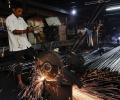
India's industrial production growth slowed down for a fourth straight month in December to 0.4 per cent mainly due to a poor performance by the manufacturing sector. The manufacturing sector, which constitutes 77.63 per cent of the Index of Industrial Production (IIP), contracted by 0.1 per cent in December, according to the data released by the National Statistical Office (NSO) on Friday. In December 2021, the mining output rose by 2.6 per cent, and power generation increased by 2.8 per cent.

In a first, the Comptroller and Auditor General's (CAG) officers reached out to several ministries in the last week of April as part of a confidence-boosting measure. The meeting brought the CAG officials and those from the ministries across the table to discuss the pain points in their relations. CAG of India Girish Chandra Murmu took this novel step because of growing tensions between those audited and the auditor.

With Prime Minister Narendra Modi on Wednesday inducting four new faces from Karnataka into his ministry, and chemicals and fertilisers minister D V Sadanda Gowda resigning ahead of the reshuffle, the state's representation in the Union council of ministers now stands at six.

Hindustan Zinc (HZL), a subsidiary of Vedanta, announced an interim dividend of Rs 21 per share last week, resulting in an outflow of Rs 8,863 crore. The announcement has turned the spotlight on India Inc's dividend-paying policy - more so for reasons driving the generosity of firms. An analysis of BSE 500 companies by Business Standard Research Bureau shows that some of the top 20 dividend-paying companies in 2021-22 (FY22) include Vedanta, Tata Consultancy Services, HZL, Oil and Natural Gas Corporation (ONGC), Indian Oil Corporation (IndianOil), Hindustan Unilever (HUL), Reliance Industries (RIL), and Bajaj Auto, among others.

FDI is a major driver of economic growth and a source of non-debt finance for the economic development of the country. The government has put in place an investor-friendly policy on FDI, under which investment up to 100 per cent is permitted on the automatic route in most sectors/ activities. At $ 64.37 billion, FDI in 2018-19 is the highest ever investment received for any financial year.

Narendra Modi has made it easier for businesses to buy farm land.
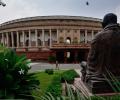
The much-anticipated cryptocurrency bill, however, is missing from the list, reports Shrimi Choudhary.

Of these 36 coal blocks, one mine will be given to the steel sector while the rest will be given to the power sector.
